

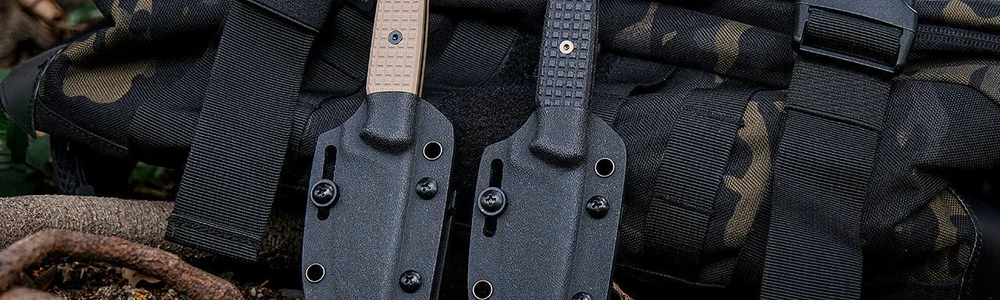
Camping Knife Essentials: Your Guide to Choosing the Right Blade for the Outdoors
For any outdoor enthusiast, a camping knife isn’t just another piece of gear; it’s an indispensable companion, often stepping in precisely when plans shift or nature presents an unexpected challenge. One moment you might be effortlessly slicing fresh fruit for a trailside snack, and the next, you could be meticulously trimming cordage for a makeshift shelter or expertly carving kindling to coax a reluctant fire to life.
A truly reliable knife empowers you to cook, make essential repairs, construct temporary structures, and maintain a crucial sense of safety, all without the frustration of rummaging through your pack for a specialized tool. However, it’s vital to understand that not all knives are crafted to withstand the rigors of genuine outdoor use.
This comprehensive guide will delve into the critical elements that define a dependable camping knife, walk you through the process of selecting one that perfectly aligns with your outdoor style, and illustrate why the right blade will quickly become the first item you instinctively reach for every time you venture into the great outdoors.
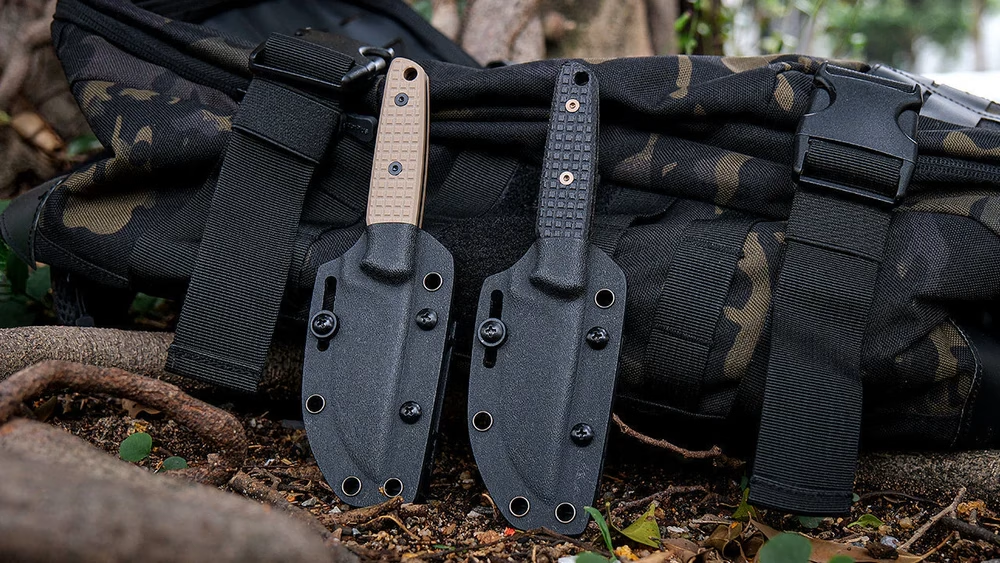
Why a Good Camping Knife Is a Must-Have
Venturing into the wilderness means embracing the unpredictable. From sudden weather shifts to unexpected gear malfunctions or the simple need to process natural materials, anything can happen. A high-quality camping knife doesn’t just prepare you for these eventualities; it equips you with a profound sense of control and confidence, transforming potential challenges into manageable tasks. It’s the ultimate multi-tool that simplifies your outdoor experience in countless ways:
- Food preparation becomes effortless. Imagine effortlessly slicing cheese, dicing fruit, portioning sausage, or even cleaning a freshly caught fish without needing to lug a bulky kitchen knife into the backcountry. A sharp camping knife makes campsite culinary tasks a breeze.
- Fire-building is streamlined and efficient. This essential tool allows you to quickly shave fine tinder, split small pieces of kindling, or, if your knife features a sharp-edged spine, even strike a ferro rod to ignite your fire with precision and ease.
- Gear repairs are quick and simple. When your tent guy line frays, your pack strap needs a quick adjustment, or you need to trim duct tape for an emergency patch, a reliable knife cuts cord, shapes tent pegs, and handles minor repairs in mere seconds, preventing small issues from becoming big problems.
- Shelter setup gets smoother. Whether you’re pitching a tarp, setting up a hammock, or constructing a lean-to, a knife is invaluable for trimming branches, sharpening poles, or cutting guy lines to achieve the perfect tension and configuration.
- Your safety significantly improves. Beyond its utility, a knife can be a critical safety tool. Use it to clear trail obstructions, pry open frozen zippers, or even signal for help by reflecting sunlight off its blade in an emergency.
- Your pack becomes noticeably lighter. By consolidating the functions of scissors, a dedicated food knife, and various small tools, one versatile and reliable camping knife significantly reduces the weight and bulk in your loadout, allowing you to carry less while accomplishing more.
Once you’ve experienced the sheer utility and peace of mind that comes with a proper camping knife, you’ll quickly realize it’s not just an accessory—it’s an absolute necessity you won’t want to leave home without.
What to Consider Before Choosing Your Camping Knife
With countless options on the market, selecting the ideal camping knife can feel overwhelming. The key is to find a blade that doesn’t just look good but truly complements your unique outdoor style and the demands of your adventures. Here are the crucial factors to meticulously consider before making your choice:
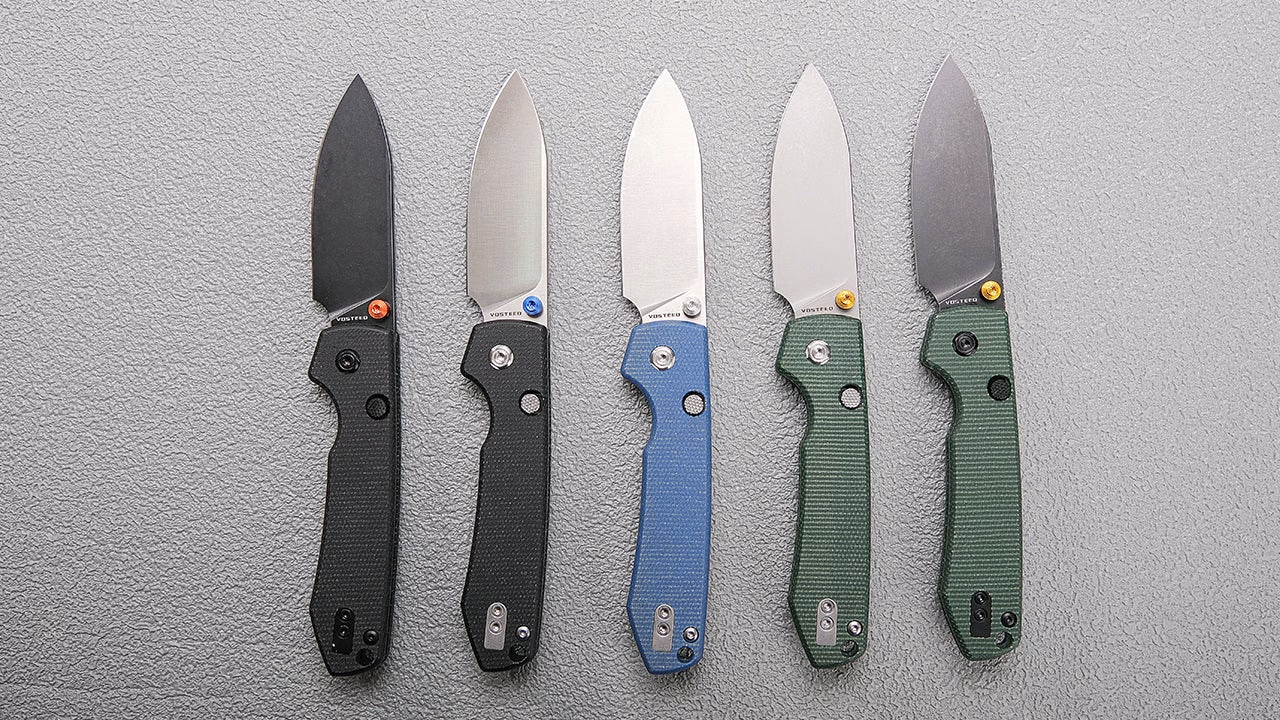
Blade Steel: The Heart of Your Knife
The type of steel used in a knife’s blade directly dictates its performance, durability, and ease of maintenance in the field.
For a reliable camping knife, the steel should exhibit excellent corrosion resistance, maintain a sharp edge through rigorous use, and be relatively straightforward to sharpen when you’re far from a workbench. While many excellent steels exist, 14C28N stainless steel stands out as a remarkably strong, all-around choice for outdoor applications. It boasts impressive rust resistance, meaning you won’t be battling unsightly corrosion after a damp trip.
Furthermore, it sharpens with surprising ease, allowing for quick touch-ups even with basic field sharpeners, and it holds a working edge exceptionally well through repeated cutting tasks. This particular steel strikes a superb balance: it’s tough enough to handle demanding wood processing tasks, yet clean and safe enough for direct food contact. Its ability to respond well to both fine honing and quick field touch-ups makes it a favorite among seasoned campers.
Blade Shape: Form Meets Function
The shape of a knife’s blade profoundly influences its utility for different tasks. Understanding the common shapes will help you match the knife to your primary needs:
- Drop Point: Characterized by a convex curve from the spine to the tip, creating a strong, controllable point. This shape offers a generous belly, making it exceptionally versatile for slicing, skinning, and general food preparation. Its robust tip is less prone to breaking, making it a reliable all-rounder for camp tasks.
- Clip Point: Features a concave or straight cut-out on the spine near the tip, giving it a finer, sharper point. This design excels at piercing and intricate carving tasks where precision is paramount. While highly effective, clip points require a bit more care around the delicate tip compared to drop points.
Both drop point and clip point designs are highly functional in a camp setting. However, it’s generally advisable to steer clear of overly extreme blade styles—such as tanto or recurve—unless your outdoor activities involve very specific, specialized tasks that genuinely benefit from their unique geometries. For most camping scenarios, versatility and durability are key.
Blade Grind: The Edge of Performance
The blade grind refers to the cross-sectional geometry of the blade, from the spine to the edge. This often-overlooked detail significantly impacts a knife’s cutting efficiency and how easily it can be maintained. Among the various grinds, a flat grind is particularly well-suited for a camping knife. In a flat grind, the blade tapers uniformly from the spine all the way to the cutting edge.
This design provides robust edge support and allows the blade to slice smoothly through a wide array of materials, be it rope, meat, wood, or plastic. It creates minimal drag during cuts, facilitating cleaner and more efficient push cuts, which is especially beneficial for food preparation or detailed camp work. An added advantage of flat grinds is their ease of sharpening, even with rudimentary tools, making field maintenance during extended trips far less cumbersome. They truly strike a practical balance between sheer toughness and superior slicing power.
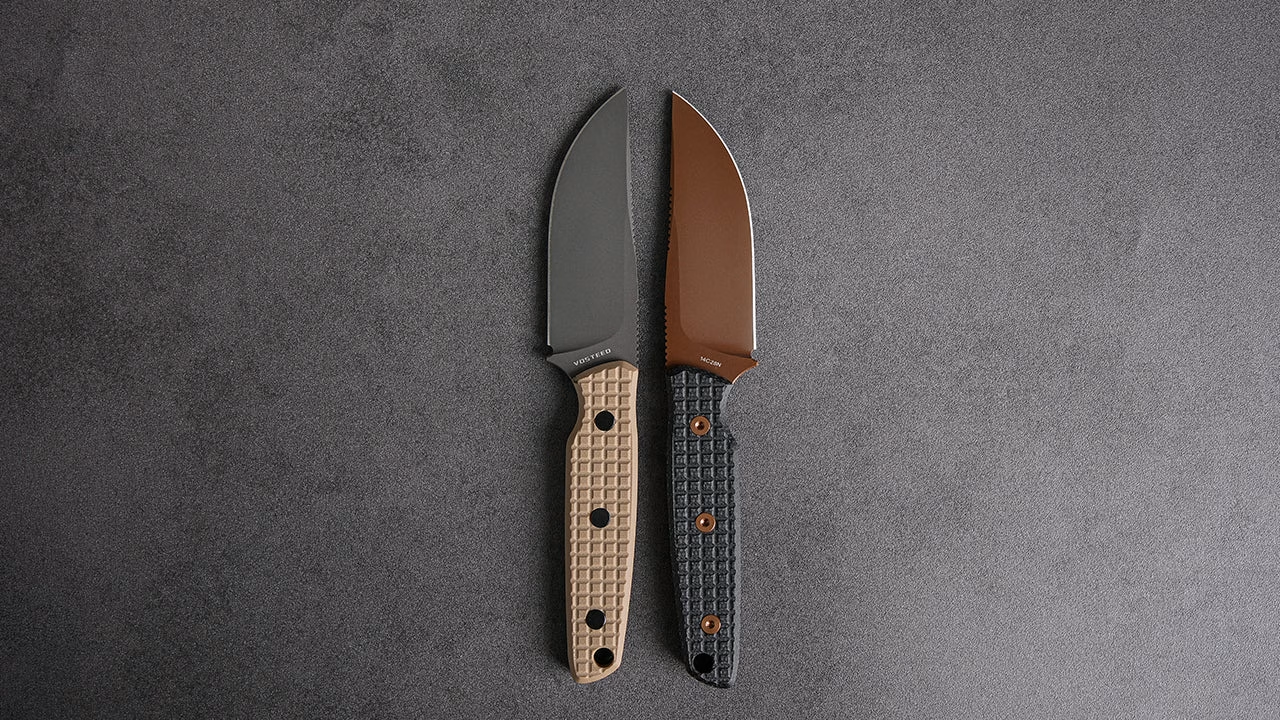
Full Tang or Folding: Strength vs. Portability
One of the most fundamental decisions when choosing a camping knife revolves around its construction a fixed blade with a full tang or a folding knife. Each offers distinct advantages:
- Full Tang Fixed Blades: These knives are the epitome of durability and strength. In a full tang design, the blade steel extends in one continuous piece through the entire length of the handle. This construction eliminates moving parts and potential failure points, providing superior leverage and making them ideal for demanding tasks like chopping, batoning wood (splitting wood by striking the spine of the blade with another piece of wood), and critical survival applications.
If your adventures involve heavy-duty work or you prioritize unwavering reliability, a full tang fixed blade is the superior choice.
- Folding Knives: Valued for their compactness and portability, folding knives are incredibly convenient to carry in a pocket or attach to gear. They are excellent for lighter chores, quick access tasks, and situations where space is at a premium. If you’re a minimalist hiker or need a reliable backup blade for everyday camp use, a folder is an invaluable tool. However, for primary, heavy-duty outdoor use, a fixed blade will always offer greater inherent strength and reliability due to its monolithic construction.
For many experienced campers, the optimal solution is to carry both: a robust fixed blade for demanding tasks and a compact folding knife for quick, everyday utility. This combination ensures you’re prepared for virtually any situation the wilderness throws your way.
Handle Design: A Secure Grip is a Safe Grip
The handle of your camping knife is just as critical as its blade, as a secure grip is paramount for both efficiency and safety. When selecting a knife, pay close attention to the materials and ergonomics of the handle.
Materials like G10 and Micarta are highly recommended for their exceptional traction, even when wet from rain or sweat. Micarta, a linen or paper-based laminate, often provides a slightly softer, more natural feel in hand, conforming comfortably over time. G10, a fiberglass laminate, is renowned for its rigidity and superior resistance to water, chemicals, and extreme temperatures.
Beyond material, the handle’s design should fit comfortably and securely in your hand without creating ‘hot spots’—areas of concentrated pressure that can lead to discomfort or blisters during prolonged use. Features such as finger grooves, a subtle palm swell, and a front guard (or choil) are crucial for preventing accidental slips, especially when performing strenuous tasks. For knives that will be used for hours on end—such as during campsite setup or extensive wood processing—a handle that remains comfortable and secure under pressure is non-negotiable.
Carry Options: Always Within Reach
How you choose to carry your camping knife significantly impacts its accessibility and, consequently, how often and effectively you use it.
An ideal carry system ensures fast, secure access while keeping the blade protected. For fixed blades, a custom-molded Kydex or durable polymer sheath is often preferred. These materials offer excellent retention, ensuring the knife stays put until needed, and allow for quick, one-handed deployment. Look for sheaths with adjustable belt clips, options for ‘scout carry’ (horizontally on the back), or integrated lanyard holes for versatile attachment to your gear. For folding knives, a robust and reversible pocket clip is essential, allowing for convenient, tip-up or tip-down carry that suits your preference and keeps the knife readily available for urban travel or day hikes. If you typically carry a backpack, consider where the knife will ride—on your hip, securely attached to a shoulder strap, or tucked into an easily accessible pouch. The easier and more intuitive it is to reach your knife, the more it will become an integral and invaluable part of your outdoor routine.
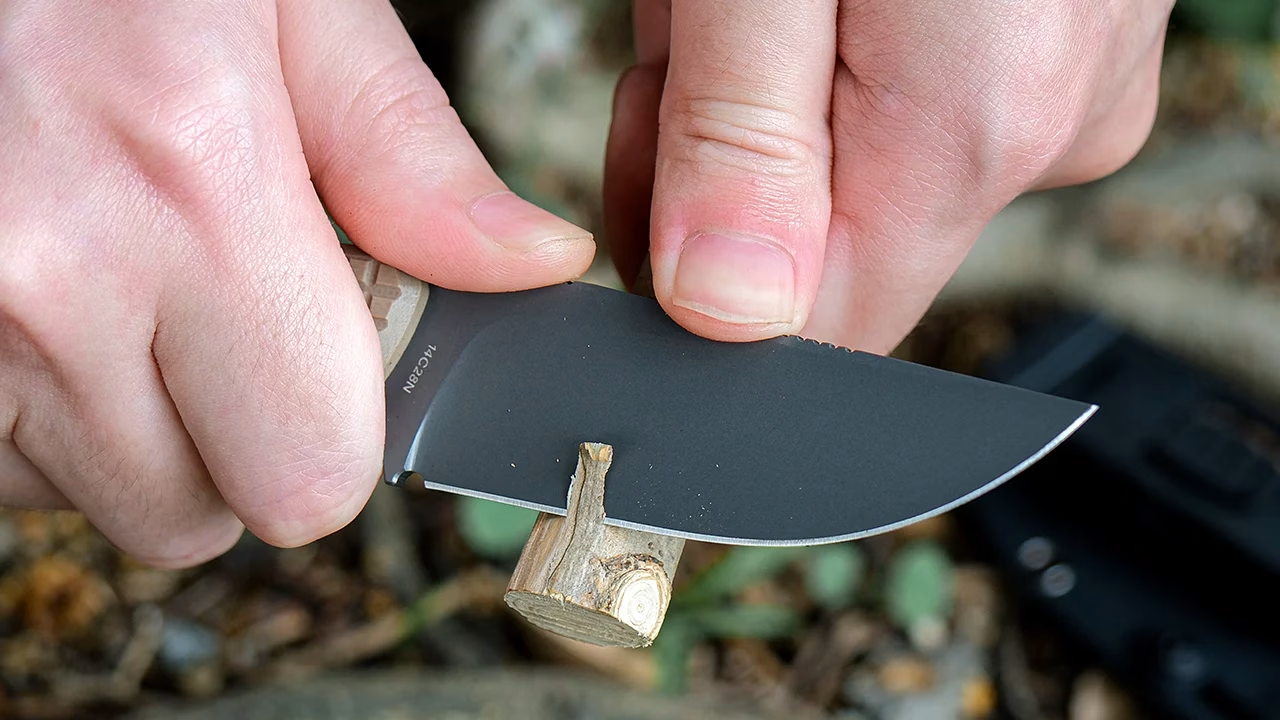
Fixed Blade vs. Pocket Knife: Which One Fits Your Adventure?
The choice between a fixed blade and a pocket knife often comes down to the nature of your outdoor adventures and your personal preferences.
Both have their distinct advantages, and understanding these can help you make the best decision for your needs:
- Fixed Blade Knives: These are the workhorses of the wilderness. With their robust, unyielding construction, fixed blades are inherently stronger and more reliable, making them ideal for demanding tasks. Think batoning wood for a campfire, preparing game, carving tools, or even constructing a makeshift shelter. Their full-tang design (where the blade steel extends through the entire handle) ensures maximum strength and leverage, allowing them to withstand significant stress without failure.
If your trips involve overnight stays, extended treks into rugged terrain, or off-trail exploration where durability and raw power are paramount, a fixed blade is an exceptionally smart and safe choice.
- Pocket Knives: In contrast, pocket knives prioritize convenience and portability. They are designed to be compact, lightweight, and easily carried in a pocket or attached to gear, making them perfect for quick, everyday tasks around camp or on a day hike.
While they may not offer the brute strength of a fixed blade, modern folding knives feature increasingly strong locking mechanisms and smooth opening actions, making them highly practical for food preparation, cutting cordage, opening packages, or handling general utility tasks. If you value quick access, minimal bulk, and versatile cutting ability for lighter chores, a well-designed pocket knife is an excellent companion.
So, which one is better? The answer, as with many things in the outdoors, often depends on the specific situation. For heavy-duty use, rough conditions, or multi-day expeditions, a fixed blade is generally superior.
For quick access, compact carry, and simpler cutting needs, a pocket knife excels. Many seasoned campers find the optimal solution is to carry both: a sturdy fixed blade for the heavy lifting and a nimble pocket knife for all the smaller, frequent tasks. This dual-knife approach ensures you’re prepared for anything, from the most arduous bushcraft to the simplest camp chore.
Our Top Picks: Essential Camping Knives for Your Next Outdoor Trip
Having explored the critical factors that define an exceptional camping knife, let’s dive into some top-rated options that are built to excel in real-world outdoor scenarios. These selections represent a blend of thoughtful design, durable materials, and reliable performance, ensuring they’ll be trusted companions on your adventures.
Vosteed Mink – The Unyielding Fixed Blade for Demanding Tasks
If your outdoor pursuits frequently involve rigorous tasks, the Vosteed Mink fixed blade knife is engineered to meet the challenge. Despite its slim profile, this knife is a true workhorse, designed for resilience and efficiency in tough conditions. It delivers exceptionally smooth cuts and maintains its sharpness even after extensive use, performing admirably in various weather conditions.
Key Specifications:
- Blade Length: 3.33 inches
- Blade Material: 14C28N stainless steel
- Blade Style: Clip point with flat grind
- Handle: Textured G10 in sand color
- Weight: 3.15 oz (without sheath)
- Sheath: Kydex with adjustable clip
The Mink’s design incorporates dual jimping on the spine, providing superior grip and control, particularly beneficial for precise push cuts.
Its compact size belies its powerful cutting capability, making it an ideal tool for preparing firewood, constructing shelters, and handling a wide array of field tasks with confidence. The textured frag-pattern handle ensures a secure hold, even when your hands are wet or gloved, enhancing both safety and performance. Accompanied by a robust black Kydex sheath, the Vosteed Mink remains securely on your belt, always ready for immediate action, embodying reliability when you need it most.
Vosteed Raccoon Top Liner Lock – The Agile Pocket Companion
For those who prioritize portability and quick access without compromising on performance, the Vosteed Raccoon Top Liner Lock pocket knife offers a compelling blend of elegance and outdoor functionality. This knife is a testament to thoughtful engineering, designed to be a seamless extension of your hand for everyday camp tasks and beyond.
Key Specifications:
- Blade Length: 3.25 inches
- Blade Material: 14C28N stainless steel
- Blade Style: Drop point with flat grind
- Handle: Green Micarta, U.S. Patented
- Lock: Top liner lock
- Weight: 3.00 oz
- Clip: Reversible stainless steel, tip-up carry
The Raccoon features a beautifully chamfered Micarta handle that provides a comfortable and secure grip, adapting well to various hand sizes and grip styles.
Its versatile drop point blade effortlessly handles a range of tasks, from preparing food and cutting cordage to general camp utility.
The top liner lock mechanism is both strong and intuitive, ensuring reliable blade security during use, while ceramic bearings contribute to its remarkably smooth and fluid action. Finished in attractive Copper Dune tones, including its hardware, the Vosteed Raccoon is a refined yet tough companion, perfectly suited for daily carry or as a dependable blade for longer outdoor excursions.
How to Take Good Care of Your Camping Knife: Longevity in the Wild
A knife, at its core, is a tool. Like any valuable tool, its longevity, performance, and safety are directly tied to how well you maintain it. Treating your camping knife with proper care ensures it remains sharp, strong, and reliable for countless adventures to come. Here are some fundamental care steps that will significantly extend the life and utility of your blade:
- Clean It After Every Use: This is perhaps the most crucial step. After each use, especially after food preparation or processing natural materials, clean your blade thoroughly with mild soap and water. Immediately wipe it completely dry to prevent rust and corrosion. Avoid leaving food residues, plant sap, or moisture on the blade for any extended period, as these can lead to pitting or staining, particularly on stainless steel.
- Keep It Sharp: A dull knife is not only inefficient but also far more dangerous than a sharp one. A dull edge requires more force to cut, increasing the risk of slippage and injury. Regularly maintain your edge using a ceramic rod, whetstone, or a portable sharpening system. Even a quick touch-up can make a significant difference in performance and safety. Learn to sharpen your knife effectively, and you’ll always have a reliable edge.
- Check the Handle and Screws: For folding knives, periodically inspect all screws and pivot points for any looseness. If you find any, gently tighten them to ensure the blade deploys smoothly and locks securely. For fixed blades, ensure the handle remains firm and free of any wobble. If the handle scales or fasteners become loose, re-tighten or replace them as needed. A secure handle is vital for safe and effective use.
- Store It Dry: Moisture is the enemy of steel. After cleaning and drying, always store your knife in a dry environment. If using a sheath, ensure it’s also dry before re-sheathing the knife. For carbon steel knives (which are more prone to rust than stainless steel), apply a light coat of oil—such as mineral oil or a specialized knife oil—to the blade before storage. This creates a protective barrier against moisture and corrosion.
- Carry It Safely: Always use a proper sheath for fixed blades or a deep-carry clip for folding knives. Never carry a knife loose in your backpack or pocket where it can get damaged, damage other gear, or, most importantly, cause injury to your hand when reaching into your bag. A secure carry method protects both you and your knife.
By following these simple yet essential care practices, your camping knife will not only perform optimally but will also become a trusted, long-lasting companion on all your outdoor expeditions.
Conclusion: Your Trusted Companion in the Wilderness
Ultimately, a truly exceptional camping knife should feel like a natural extension of your hand—ready at a moment’s notice, resilient under pressure, and effortlessly integrated into your outdoor routine. Whether you’re embarking on a quick overnight escape or a multi-week off-grid expedition, the right blade brings an unparalleled sense of control, comfort, and confidence to every task.
The Vosteed Mink, with its unyielding fixed blade design, stands out for heavy-duty roles, proving its worth when the going gets tough. Conversely, the Vosteed Raccoon Top Liner Lock offers a smart, highly packable option for all your everyday camp tasks, blending refined aesthetics with robust functionality.
The key is to choose a knife that aligns perfectly with your specific camping style and the demands of your adventures. Once you do, your camping knife will transcend its identity as mere tool, transforming into an indispensable habit—one you’ll be profoundly grateful to have brought along. Discover more essential gear for your outdoor adventures in our comprehensive guide: camping gear list for beginners